Squad Capital: Why the Smartest Young Hustlers Are Building Wealth Together Instead of Alone

There's a version of the success story we've all been fed since birth: the lone visionary, grinding in obscurity, betting everything on their singular talent, eventually breaking through on the strength of pure individual will. It's a compelling narrative. It's also, for most people in most cities, a slow and unnecessarily painful way to build anything.
Across urban America right now, a quieter and more interesting story is playing out. In converted warehouses in Detroit, shared lofts in Atlanta, group houses in East Austin, and collective studio spaces in Bed-Stuy, young hustlers are discovering something that older generations of business owners have always known but rarely talked about publicly: the most efficient unit of wealth-building isn't the individual. It's the crew.
Call it squad capital. Call it the collective hustle. Whatever you call it, it's working — and it's working fast.
Why Solo Grinding Has a Ceiling
Let's start with the math. The average young professional in a major American city is allocating somewhere between 30 and 50 percent of their take-home pay to housing alone. Add student loans, transportation, food, and the basic cost of maintaining a life in an expensive urban environment, and the discretionary capital available for investing in a creative project, a business idea, or a side hustle is often razor-thin.
This isn't a discipline problem. It's a structural one. The economics of city life are calibrated for people who already have capital, and building something from scratch when your margins are this tight requires either extraordinary luck, an unusually supportive family, or a fundamentally different approach to how you accumulate and deploy resources.
The collective model solves this by treating the group's combined resources — financial, creative, social, and spatial — as a single pool that everyone draws from and contributes to. The math changes completely when you split a $1,500 monthly studio rental six ways. When five people each put in $200 toward equipment, you've got a $1,000 gear budget that none of you could have swung individually. When eight people in a group chat all promote the same release on the same day, you've got a coordinated marketing push that no single creator could replicate alone.
The Music Collective Model
Noplace is the collective hustle more visible — or more historically proven — than in music. The greatest creative movements in American music history were almost never solo acts at their origin. Motown was a collective. The Wu-Tang Clan was a collective. Odd Future was a collective. The early Chicago drill scene was a collective. What these movements understood intuitively was that shared infrastructure, shared aesthetics, and shared audiences create a rising-tide effect that benefits everyone involved faster than individual promotion ever could.
Today's version of this model is playing out in cities like Atlanta, Houston, and LA, where tight-knit groups of producers, engineers, artists, and creatives are pooling resources to build independent labels, shared studios, and collective brands that give each member more leverage than they'd have flying solo.
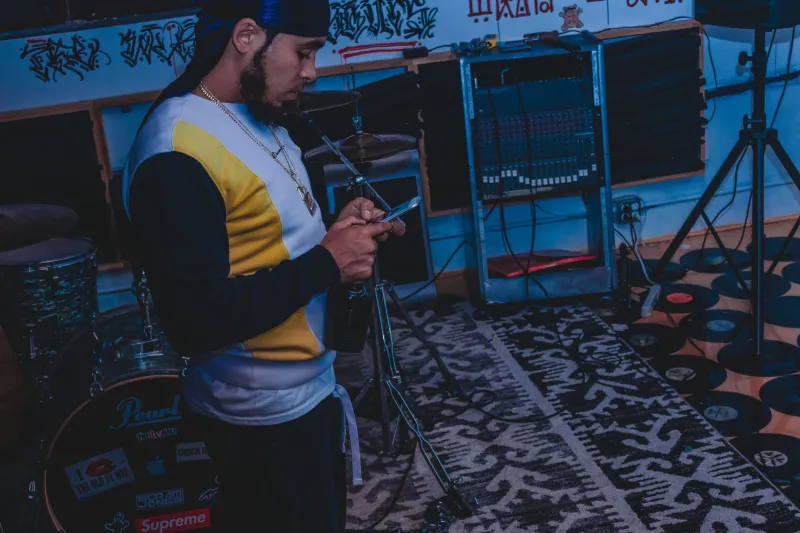
Consider what it looks like in practice: a group of six artists shares the lease on a recording space, cutting each person's monthly cost from a prohibitive $800 to a manageable $135. They share equipment, share session time, and — critically — share audiences. When one member drops a project, the entire collective promotes it. When one member books a show, others open. The network effects compound over time into something that starts to look like a genuine independent music operation, built entirely without label money or outside investment.
Creative Co-Ops Beyond Music
The collective model isn't limited to music, though that's where it's most culturally visible. Across American cities, informal creative cooperatives are springing up around photography, visual art, fashion, content creation, and even food. These aren't formal business entities in most cases — they're friendship-based ventures built on trust, shared values, and a mutual understanding that everyone is stronger together than apart.
In cities like Portland and Philadelphia, photographer collectives are splitting the cost of studio rentals and equipment packages, then using the collective's combined portfolio to pitch clients that none of them could land individually. In Chicago, groups of food entrepreneurs are sharing commercial kitchen space — a cost that can run $25 to $40 an hour individually — to develop products and pop-up menus that are generating real revenue.
The fashion world has seen this too, particularly in streetwear, where small collectives of designers, photographers, and stylists are pooling resources to produce lookbooks, pop-up shops, and limited drops that create genuine market buzz without the overhead of a traditional brand launch.
The Trust Problem and How to Solve It
Here's the honest complication nobody wants to lead with: collective models require a level of interpersonal trust that's genuinely hard to build and easy to break. Money and friendship are a volatile combination, and the history of group ventures is littered with collapsed friendships and soured partnerships that started with the best intentions.
The collectives that survive — and thrive — almost always have a few things in common. First, they start small and build trust incrementally before escalating financial commitment. A group that spends six months successfully executing small collaborative projects before signing a lease together is far more likely to survive a disagreement than one that jumps straight into a major financial arrangement.
Second, they get things in writing early, even when it feels awkward. The most common killer of collective ventures isn't conflict — it's ambiguity. Who owns what? How are decisions made? What happens when someone wants to leave? Having honest, documented answers to these questions before problems arise is the single best investment a collective can make in its own longevity.
Third — and this is the one that sounds soft but matters most — they're intentional about maintaining the social fabric of the group outside of business contexts. The collectives that last are the ones where people genuinely like each other, celebrate each other, and treat the group's success as their own success. The ones that collapse are usually the ones where the business relationship crowded out the human one.
Building Your Own Collective
If you're reading this and thinking about the people already in your orbit — the ones with complementary skills, aligned ambitions, and the kind of work ethic that makes you want to be in the room with them — you might already have the raw material for something real.
Start with a conversation. Not a pitch, not a business plan — a genuine, exploratory conversation about what everyone wants to build and what everyone brings to the table. Map the skills in the room. Identify the shared resource that would make the biggest collective difference — a space, a piece of equipment, a marketing budget, a shared audience. Find the smallest possible version of that collaboration and do it well.
The city is full of people grinding alone toward goals they could reach faster together. Squad capital is the cheat code hiding in plain sight. All it takes is the humility to admit you don't have to do it by yourself — and the wisdom to choose the right people to do it with.